
More project photos (5)
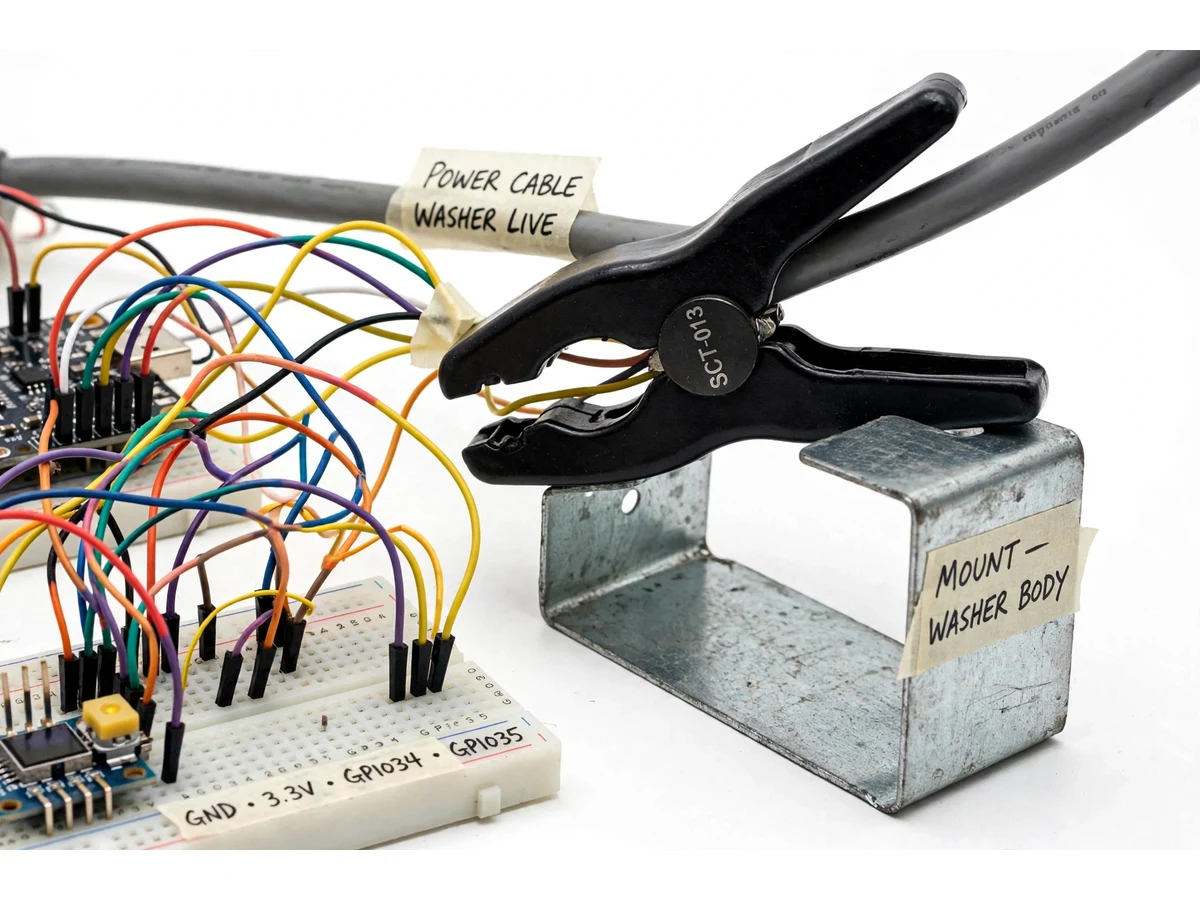
The problem
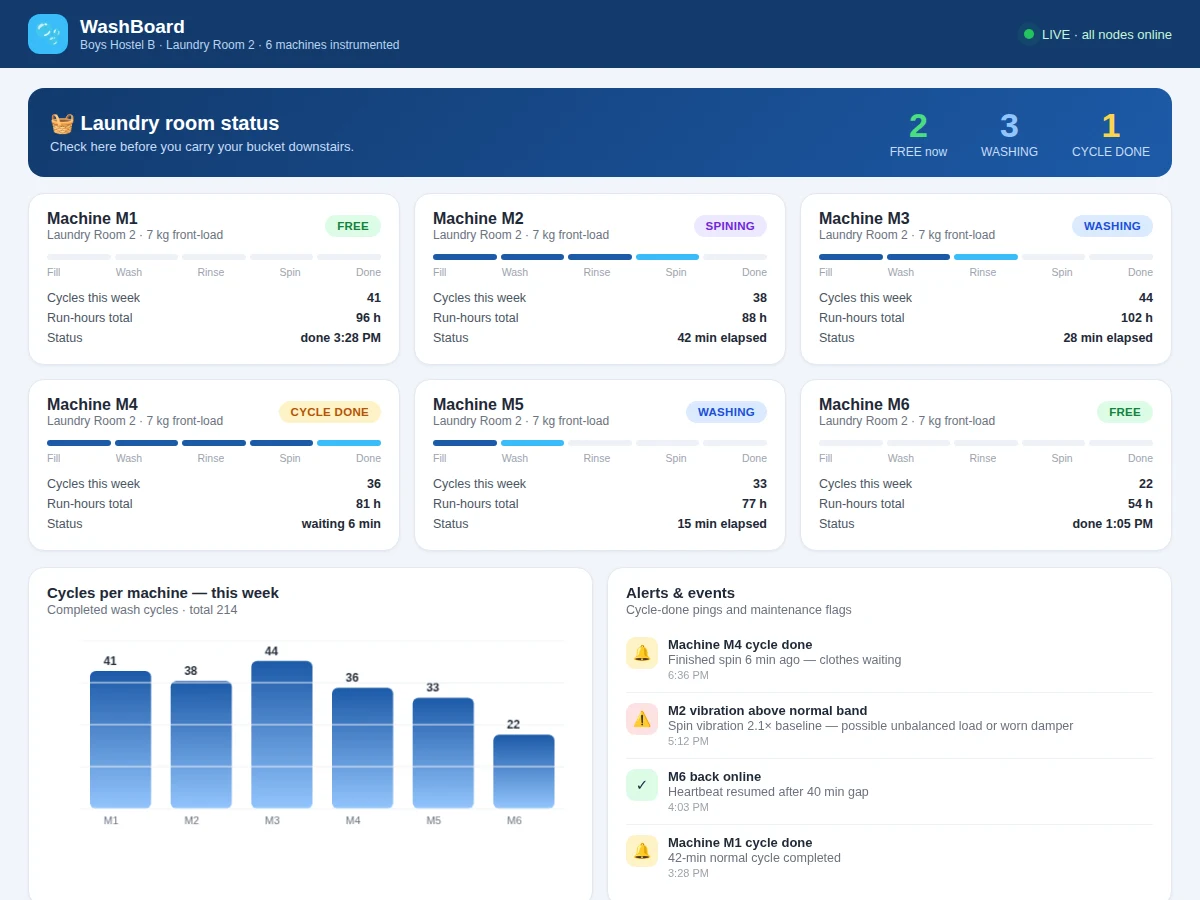
Shared washing machines in hostels and apartment complexes are a classic commons problem: a handful of machines serve hundreds of residents, there is no booking system, and the only way to know if one is free is to walk to the laundry room. Machines run overloaded, nobody knows which one is due for service, and "someone left their clothes in for three hours" is a daily complaint. This project instruments each machine with a compact sensor node that recognizes the wash cycle from its vibration and current signature — fill, agitate, spin phases are mechanically distinct — and reports state changes over Wi-Fi. The dashboard presents a live availability board (FREE / WASHING / CYCLE DONE), per-machine cycle counts and run-hours, a done-alert feed, and flags for abnormal behavior like a machine vibrating far beyond its normal band or a cycle running far too long. The student delivers the sensing hardware and a genuinely working dashboard demo that mirrors the real deployment.
How it works
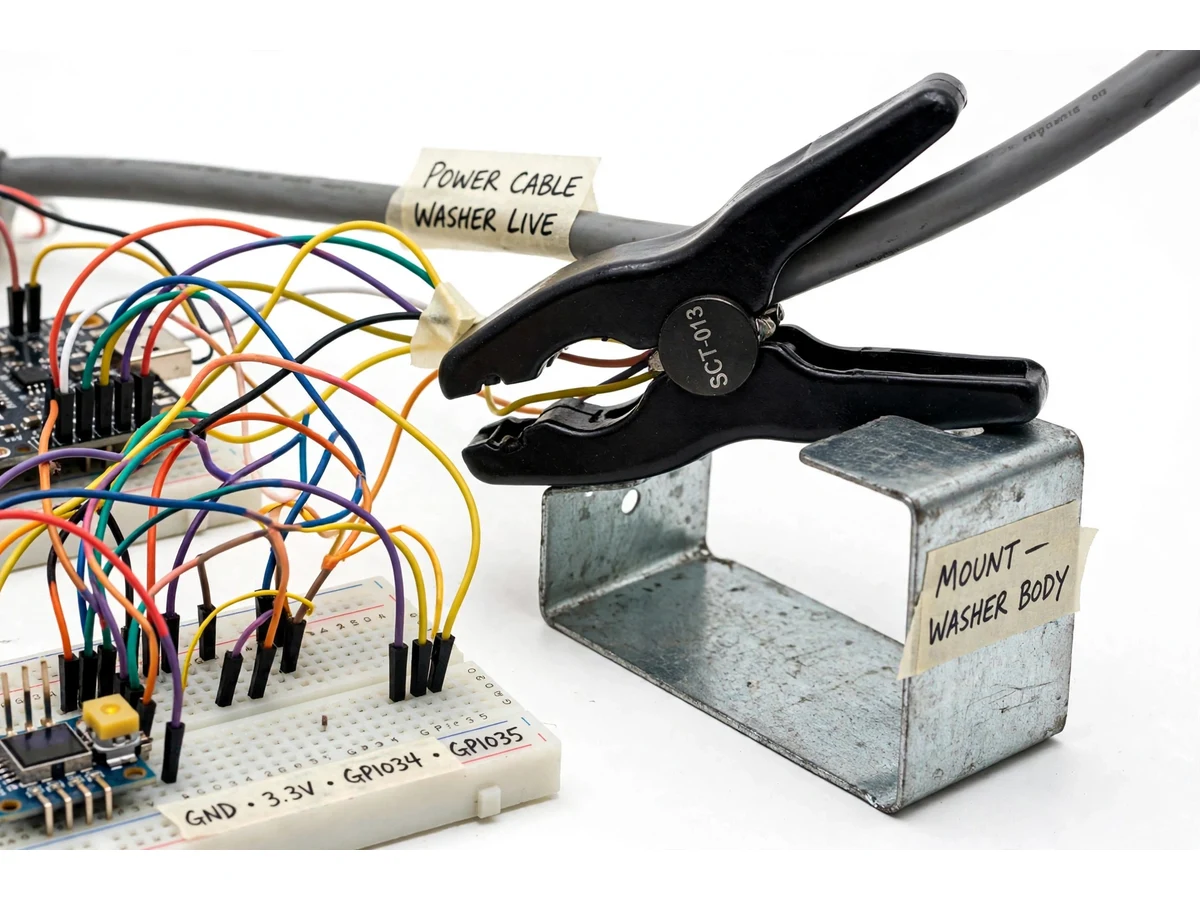
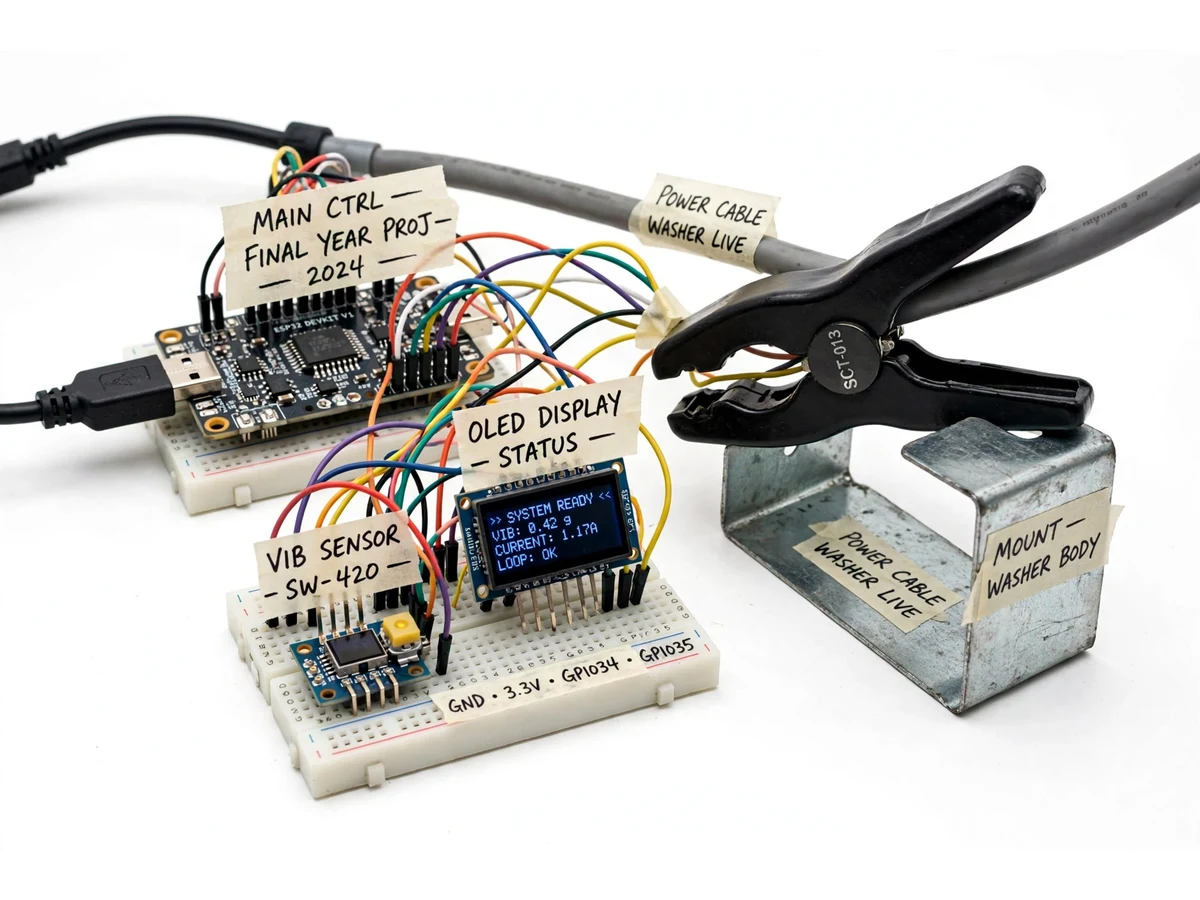
- A sensor node is mounted on each washing machine's body (vibration sensor) with a CT clamp on its supply cable — no panel is opened.
- Firmware continuously watches vibration energy and current draw, classifying the machine into IDLE, FILL, WASH, SPIN or DONE with a phase state machine and debounce timing.
- State changes are published immediately over Wi-Fi (MQTT/HTTP); a periodic heartbeat confirms each node is alive.
- The backend accumulates cycle counts, run-hours and phase durations per machine; abnormal vibration or over-long cycles raise maintenance flags.
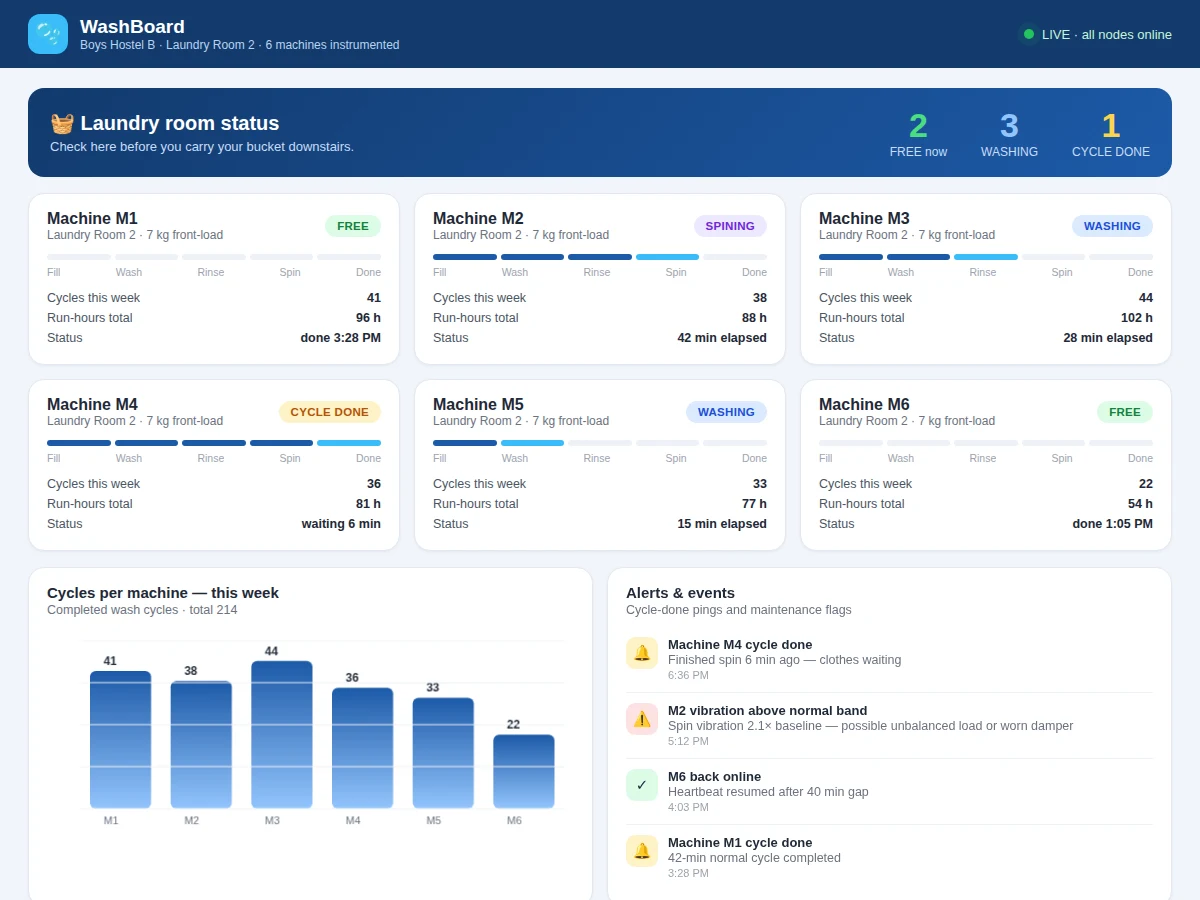
- The dashboard renders the live availability board, per-machine usage stats, the done-alert feed and the maintenance flag list.
- The student commissions the laundry room with the included procedure: run one supervised cycle per machine to learn its signature, set the phase thresholds, and validate the board against observed cycles.
Tech stack:
- ESP32 sensor nodes (one per machine)
- Vibration sensor + SCT-013 CT clamp per node
- Wi-Fi telemetry (MQTT/HTTP)
- Web dashboard (HTML/CSS/JS demo included)
- Phase state-machine firmware
- Arduino IDE (C/C++ firmware)
- 5 V USB power per node
| Parameter | Value |
|---|---|
| Sensing | Vibration + current signature per machine (design) |
| States | IDLE, FILL, WASH, SPIN, DONE (design) |
| Reporting | State change immediate + heartbeat |
| Metrics | Cycle counts, run-hours, phase durations |
| Alerts | Cycle-done, abnormal vibration, over-long cycle |
| Dashboard | Availability board, usage stats, alert feed |
| Installation | External mount, no machine opened |
Project features
- [Live availability board] Each machine shows FREE, WASHING or CYCLE DONE in real time — residents check their phones instead of walking to the laundry room.
- [Cycle-phase state machine] Firmware recognizes fill, wash, rinse and spin phases from the vibration/current signature, so the board reflects reality, not a timer guess.
- [Cycle-done alerts] The moment a machine finishes, the dashboard flags it — cutting the "forgotten clothes" idle time that blocks the next user.
- [Per-machine usage logs] Cycle counts and run-hours per machine give wardens the data behind maintenance scheduling and replacement decisions.
- [Abnormal-behavior flags] Excessive vibration or abnormally long cycles raise maintenance alerts with timestamps — the early warning a warden never had.
- [Non-invasive sensing] Nodes mount externally and sense vibration plus supply current via CT clamp — no machine is opened and no warranty is voided.
- [Working demo dashboard] A single-file web dashboard with realistic simulated laundry telemetry is included for presentation and viva.
What is included
- Sensor node design (one node per machine in the demo set)
- Phase state-machine firmware with debounce logic
- Working single-file dashboard demo with simulated laundry telemetry
- Mounting and signature-learning commissioning guide
- Project report PDF (theory, sensing, state machine, dashboard, results)
- PPT presentation and viva Q&A document
Limitations & prerequisites
- Phase recognition is signature-based and approximate; heavily unbalanced loads or a machine with a failing damper produce unusual signatures the state machine may misread — stated honestly.
- Thresholds must be learned per machine model; one laundry room with mixed models needs per-machine commissioning.
- The dashboard demo ships with simulated telemetry; live data appears only after nodes are mounted and connected.
- Wi-Fi must cover the laundry room; the node buffers briefly but is not a long-term offline logger.
- It monitors machine state, not laundry ownership — it cannot tell whose clothes are inside.
- Cycle-done alerts appear on the dashboard; push notifications to phones need the notification extension listed as future scope.
Frequently Asked Questions
How does it know the wash phase?
Fill, wash, rinse and spin are mechanically distinct: fill is quiet with inlet-valve current, wash is rhythmic agitation, spin is sustained high vibration. The firmware's state machine watches vibration energy plus current to track phases.
Do you have to open the washing machine?
No — nodes mount externally on the body and the CT clamp clips around the supply cable. Nothing is opened, no warranty is voided; the guide documents the fitting.
What does the dashboard show?
A live availability board (FREE / WASHING / CYCLE DONE per machine), per-machine cycle counts and run-hours, a done-alert feed, and maintenance flags for abnormal vibration or over-long cycles.
Does the demo dashboard need hardware?
The included single-file dashboard runs on realistic simulated laundry telemetry for presentation and viva; real nodes replace the simulator with live data through the same interface.
Can students book a machine from the dashboard?
As specified the board is informational; a booking/queue system is documented as future scope in the report.
Is this project suitable for a final-year project?
Yes — for IoT & Embedded, Electronics and Computer / IT programs. It combines non-invasive sensing, embedded state machines, telemetry and a genuinely useful dashboard. Suitable for B.E./B.Tech final-year projects in IoT & Embedded, Electronics / E&TC and Computer / IT.
Components & software requirements
- ESP32 sensor nodes (one per machine)
- Vibration sensor + SCT-013 CT clamp per node
- Wi-Fi telemetry (MQTT/HTTP)
- Web dashboard (HTML/CSS/JS demo included)
- Phase state-machine firmware
- Arduino IDE (C/C++ firmware)
- 5 V USB power per node
Delivery information
Built-to-order project. Delivery timeline is shared after order confirmation based on current queue.
Support terms
Complete documentation, setup guide, and viva preparation included. Support for setup and explanation provided.