
More project photos (2)

The problem
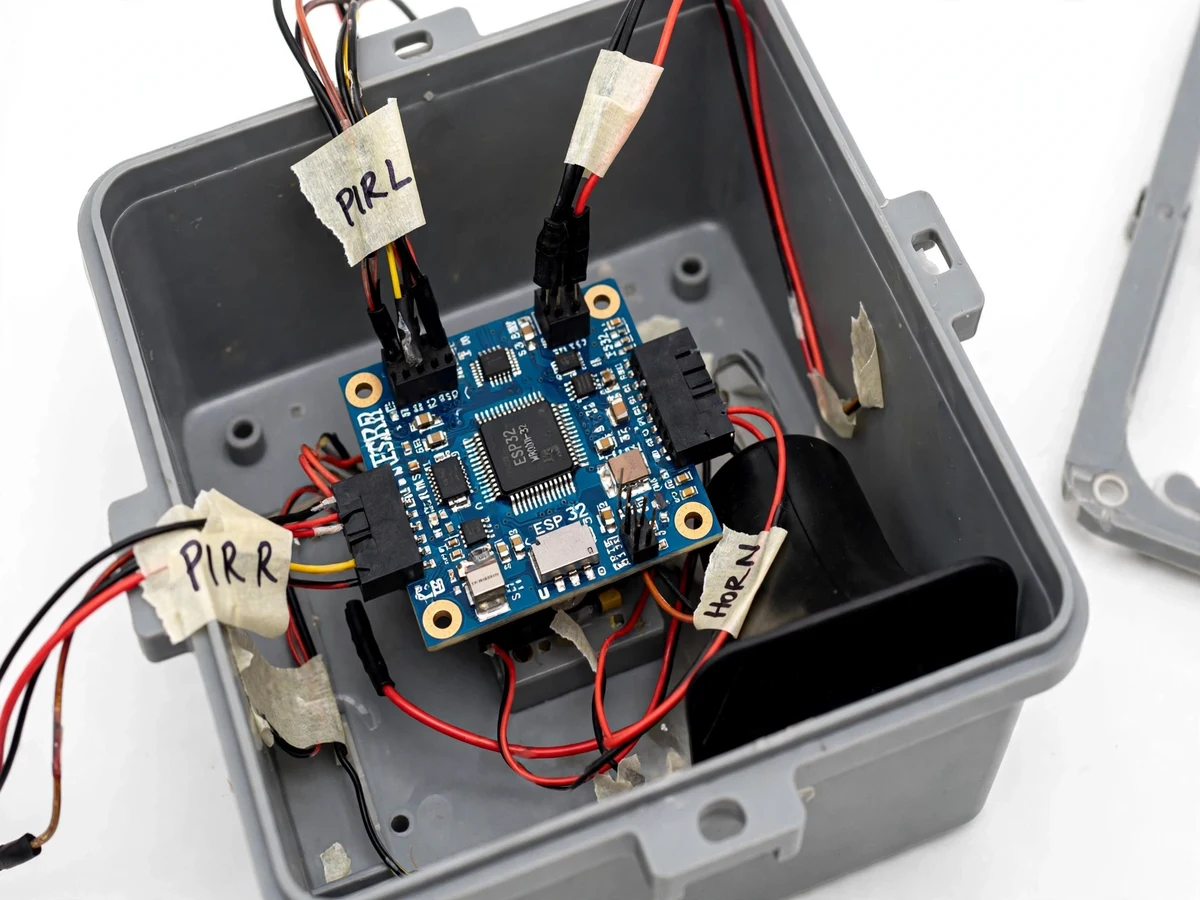
Birds can strip a standing crop in days, and farmers' traditional defenses — scarecrows, reflective tape, firecrackers — either stop working within a week or demand constant human attention. The core problem is habituation: a deterrent that always looks and sounds the same becomes background noise. This project builds an IoT bird deterrent that attacks exactly that problem: a PIR-triggered ESP32 unit that fires a randomized sequence of ultrasonic bursts, high-intensity strobe flashes and a servo-driven moving scare device, with randomized timing and intervals, while logging every detection over Wi-Fi. Solar power with battery backup keeps it running in the field without wiring. It is an honest prototype — it reduces bird visits and demonstrates the anti-habituation concept, but no deterrent keeps every bird away forever.
How it works
- The PIR sensors continuously watch the crop zone; on motion the ESP32 wakes the deterrent sequence.
- The anti-habituation scheduler picks a random combination of ultrasonic burst, strobe pattern and servo sweep for that trigger.
- Deterrents fire for a randomized duration (configurable, typically 5-20 seconds), then the unit returns to watch mode.
- Every trigger — time, deterrent mix used, battery voltage — is logged and sent over Wi-Fi to the status page.
- The solar panel tops up the battery during the day while the charge controller guards against over-charge and deep discharge.
- Quiet-hours mode (configurable times) suppresses firing at night so roosting birds are not needlessly disturbed.
Tech stack:
- ESP32 (deterrent scheduling, Wi-Fi reporting)
- Arduino IDE (firmware)
- PIR motion sensors (HC-SR501 x 2)
- Ultrasonic transducer module with randomized sweep driver
- Blynk or local web dashboard (detection log, battery status)
- 10 W solar panel, charge controller and rechargeable battery pack
| Parameter | Value |
|---|---|
| Controller | ESP32 development module |
| Detection | 2x PIR (HC-SR501), adjustable sensitivity, configurable retrigger delay |
| Deterrents | Ultrasonic bursts with randomized sweep, LED strobes, servo-driven scare panel |
| Coverage | Approximately 10-15 m radius per unit (design target, field-dependent) |
| Power | 10 W solar panel, charge controller, rechargeable battery; approximately 2-3 days autonomy (estimated) |
| Connectivity | Wi-Fi to Blynk or a local web status page |
| Enclosure | IP65-rated box with pole-mount bracket |
| Quiet hours | Configurable no-fire window |
Project features
- PIR bird detection: Two PIR motion sensors watch the crop zone and trigger the deterrent sequence on movement; sensitivity and retrigger delay are configurable in firmware.
- Randomized ultrasonic bursts: A high-power ultrasonic transducer fires bursts with randomized frequency sweep and duration so birds cannot associate a fixed tone with the device.
- Strobe flash deterrent: High-intensity LED strobes flash in randomized patterns, most effective at dawn and dusk when bird activity peaks.
- Servo-driven scare device: A servo-mounted reflective predator-eye panel sweeps randomly on each trigger, adding a moving visual threat.
- Anti-habituation scheduler: The ESP32 randomizes deterrent type, order, duration and idle intervals; a quiet-hours mode disables firing at night.
- Solar power with battery backup: A 10 W solar panel charges the battery through a charge controller; the unit is sized for approximately 2-3 days of autonomy without sun.
- Wi-Fi status reporting: Detection counts, battery voltage and the firing log are reported to a status page (Blynk or a local web server) so activity is visible without visiting the field.
- Weatherproof field build: IP65-rated enclosure, pole-mount bracket and cable glands; the wiring diagram documents every connection.
What is included
- Working prototype unit (assembled and wired)
- ESP32 firmware source code (detection, scheduler, Wi-Fi reporting)
- Wiring diagram and component list
- Project report PDF (background, anti-habituation design, methodology, test log)
- PPT presentation for final review
- Viva Q&A preparation document (PIR sensing, habituation, solar sizing, ESP32)
- Setup and field-installation guide
Limitations & prerequisites
- Habituation is a documented behavior of audible and visual bird deterrents: effectiveness typically declines over weeks, and the randomized scheduler slows this decline but does not eliminate it.
- Ultrasonic deterrence of birds has mixed support in published studies, so the unit combines ultrasound with strobe and motion deterrents rather than relying on it alone.
- Coverage is approximately 10-15 m radius per unit in open field; a large farm needs multiple units, and dense crops block the PIR line of sight.
- Solar autonomy of 2-3 days is an estimate that depends on panel orientation, sunlight hours and trigger frequency; long cloudy stretches may need manual charging.
- PIR sensors detect any warm moving object, so farm workers, livestock and large animals also trigger the deterrents.
- This is an academic prototype, not a certified agricultural product; field results vary with bird species and season.
Frequently Asked Questions
Which controller is used?
An ESP32 development module. It runs the deterrent scheduler, reads the PIR sensors, and reports detection counts and battery voltage over Wi-Fi.
Does it really keep birds away?
It reduces bird visits by combining three deterrent types with randomized timing, which is the standard anti-habituation approach. No deterrent works permanently; the report states this openly, and effectiveness varies by species and season.
What power supply does it need?
None from the grid: a 10 W solar panel with a rechargeable battery and charge controller. Estimated autonomy is 2-3 days without sun, depending on sunlight and trigger frequency.
Does it work without Wi-Fi?
Yes. Deterrent firing is fully local on the ESP32; Wi-Fi only adds the remote detection log and battery status page.
Can more deterrent types be added?
Yes. The firmware has spare GPIO pins and a modular scheduler, so a distress-call speaker, water sprayer or similar module can be added as customization.
What will I receive?
The assembled prototype unit, ESP32 firmware, wiring diagram, component list, report PDF, PPT, viva Q&A and the field-installation guide. Suitable for B.E./B.Tech final-year projects in Electronics, IoT and Embedded Systems.
Components & software requirements
- ESP32 (deterrent scheduling, Wi-Fi reporting)
- Arduino IDE (firmware)
- PIR motion sensors (HC-SR501 x 2)
- Ultrasonic transducer module with randomized sweep driver
- Blynk or local web dashboard (detection log, battery status)
- 10 W solar panel, charge controller and rechargeable battery pack
Delivery information
Built-to-order project. Delivery timeline is shared after order confirmation based on current queue.
Support terms
Complete documentation, setup guide, and viva preparation included. Support for setup and explanation provided.