
More project photos (2)
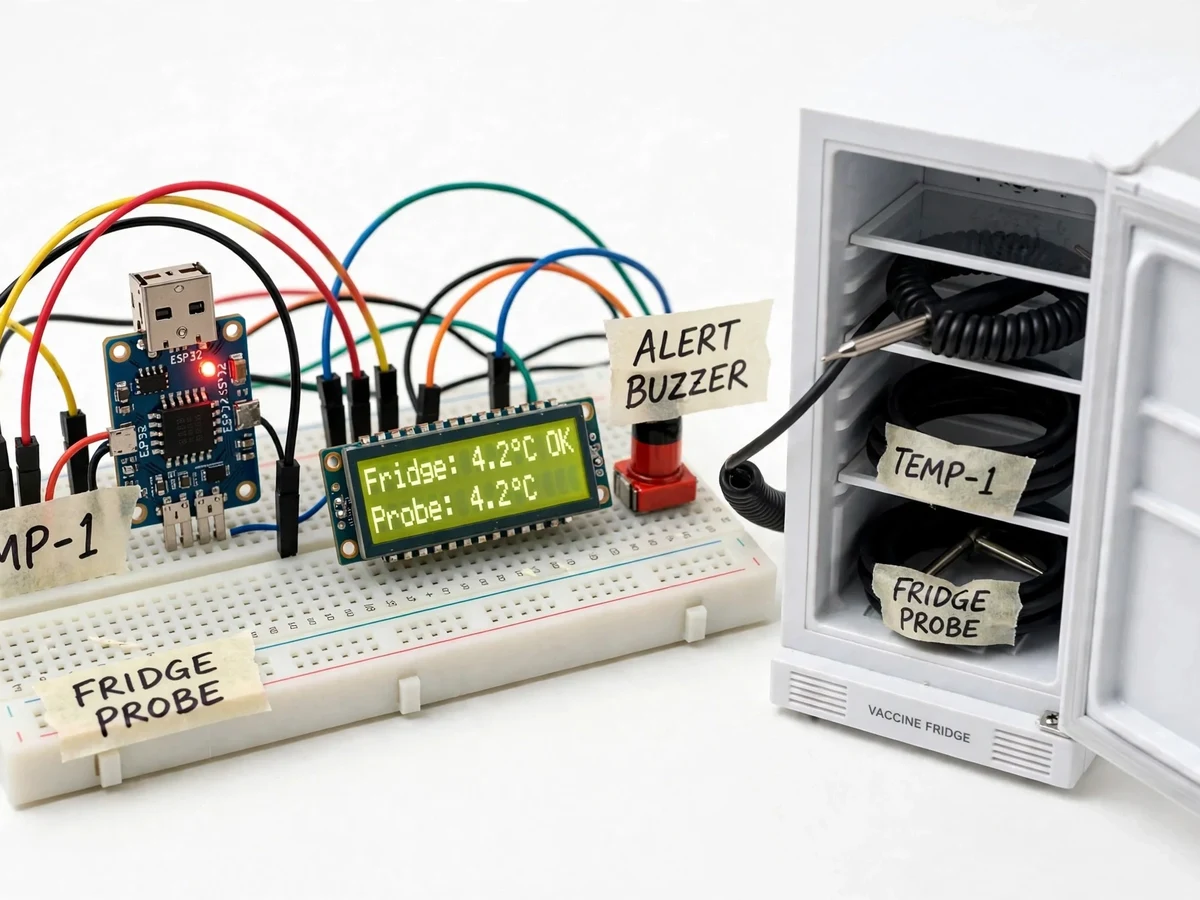
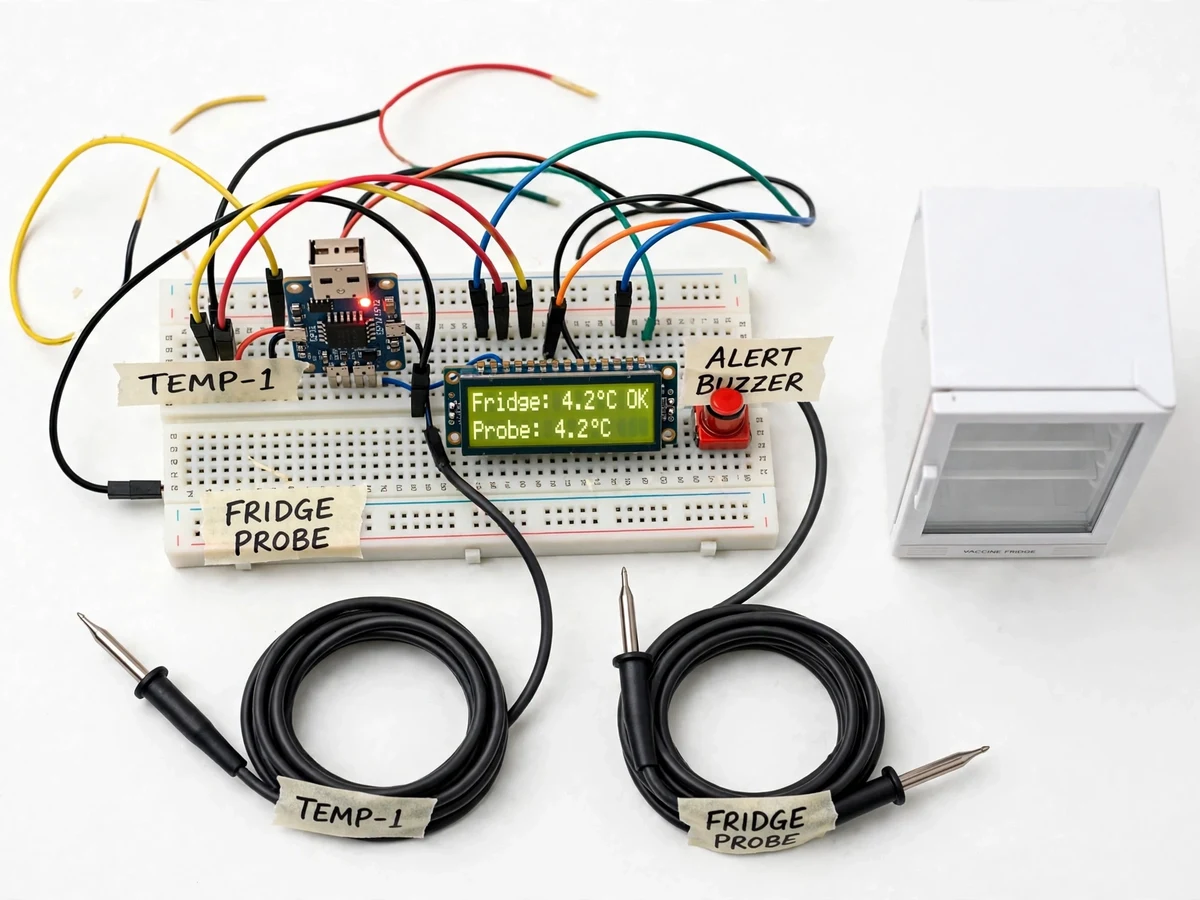
The problem
Vaccines lose potency when the cold chain breaks — a fridge that silently drifts above 8 °C for a night can waste an entire stock of expensive doses, and huge losses trace back to exactly such unnoticed excursions. Most small clinics still rely on a staff member glancing at a fridge thermometer once a day, which misses every excursion that happens overnight. This project replaces that with continuous, redundant monitoring: two waterproof DS18B20 probes watch the fridge interior, an ESP32 compares readings against the configurable 2–8 °C band, and excursions trigger an immediate local buzzer plus a remote alert. A door-open sensor catches the other classic failure mode — a door left ajar — and local buffering means the temperature log survives both Wi-Fi drops and power cuts. The build uses a compact model vaccine fridge as the demonstration unit.
How it works
- Two waterproof DS18B20 probes are placed at different heights inside the vaccine fridge and wired to the ESP32's one-wire bus.
- The firmware samples both probes every 5 seconds (configurable) and writes each reading to the local flash buffer.
- Each reading is compared against the configured 2–8 °C cold-chain band; a sustained excursion past the grace period raises an alarm.
- On alarm, the active buzzer sounds locally, the LCD switches to the alarm state, and a cloud notification is queued to the pharmacist's dashboard.
- If Wi-Fi is down, notifications and readings stay in the flash buffer; on reconnection the buffer uploads in chronological order.
- The door reed switch timestamps every open/close; a door left open beyond the grace period triggers its own alert.
- The battery backup keeps the ESP32 logging through short power cuts, with each record timestamped from the onboard RTC.
Tech stack:
- ESP32 devkit (Wi-Fi, flash logging)
- 2× DS18B20 waterproof probes (±0.5 °C per datasheet)
- 16×2 character LCD (live status)
- Active buzzer + magnetic reed switch (door)
- DS3231 RTC + Li-ion battery backup
- Arduino firmware (C++)
- Cloud dashboard / notification channel
- Ice-point calibration procedure
| Parameter | Value |
|---|---|
| Sensors | 2× DS18B20 waterproof probes, one-wire bus |
| Probe accuracy | ±0.5 °C from -10 °C to +85 °C (datasheet value) |
| Alert band | 2–8 °C (configurable) |
| Sampling interval | 5 s (configurable) |
| Logging during outages | Flash buffer + battery backup (design target: 24 h of records) |
| Battery backup | Li-ion cell, keeps logging through short power cuts (design target ~8 h) |
| Connectivity | Wi-Fi; buffered upload on reconnection |
| Display | 16×2 LCD with OK/ALARM state |
| Demo unit | Model vaccine fridge with glass door |
Project features
- [Dual-probe redundancy] Two waterproof DS18B20 probes in different fridge zones — if one probe fails or reads oddly, the system flags the mismatch instead of trusting a single bad sensor.
- [Excursion alerts] Any reading outside the configurable 2–8 °C band triggers the on-board buzzer immediately and queues a remote alert to the pharmacist's dashboard.
- [Local LCD status] A 16×2 LCD shows both probe readings live with an OK/ALARM state, so staff see the fridge health at a glance without opening the door.
- [Offline buffering] Readings are stored in the ESP32's flash during Wi-Fi or power outages (battery backup keeps logging) and uploaded when connectivity returns — no gaps in the record.
- [Door-open detection] A magnetic reed switch logs door events; an alarm fires if the door stays open beyond the configurable grace period.
- [Ice-point calibration procedure] The build ships with a step-by-step calibration guide the buyer runs (ice-water bath check, offset correction in firmware) — no fake factory calibration is claimed.
- [Configurable thresholds] Alert band, grace periods and logging interval are set through a simple configuration page, documented for the viva.
What is included
- Working prototype (ESP32 board, dual probes, LCD, buzzer, door sensor, battery)
- Arduino firmware with excursion logic, buffering and calibration routines
- Wiring diagram and assembly guide
- Ice-point calibration procedure document
- Project report PDF (cold-chain background, sensor theory, methodology, evaluation)
- PPT presentation for final review
- Viva Q&A preparation document (DS18B20 one-wire, excursion logic, buffering, RTC)
Limitations & prerequisites
- The DS18B20's ±0.5 °C accuracy is a datasheet value — no measured accuracy is claimed; the calibration procedure must be run by the buyer.
- Battery backup covers short outages (design target ~8 h); it is not a UPS for multi-day blackouts.
- Remote alerts need Wi-Fi at the clinic; without any connectivity only the local buzzer and LCD warn.
- The fridge model unit is a demonstration-scale unit, not a real pharmaceutical refrigerator.
- Temperature logging is a record, not a cure — it cannot prevent excursions, only detect and alert on them.
Frequently Asked Questions
Why two temperature probes?
Redundancy. One probe can drift or fail, and a single-probe system would either trust a bad reading or go silent. Two probes let the firmware cross-check and flag a mismatch as a sensor fault instead of a fridge fault.
What is the cold-chain band and why 2–8 °C?
It is the WHO-recommended storage range for most vaccines: below freezing damages them, above 8 °C accelerates potency loss. The band is configurable in firmware for other cold-chain goods.
What happens during a power or Wi-Fi cut?
The battery backup keeps the ESP32 sampling, and readings are written to flash with RTC timestamps. When Wi-Fi returns, the buffer uploads in order — the temperature record has no gaps.
How is the sensor calibrated?
With the supplied ice-point procedure: both probes sit in an ice-water bath (a known 0 °C reference), the firmware records the offsets, and corrections are stored. The buyer runs this themselves — nothing is claimed as factory-calibrated.
Can it stop a fridge failure?
No — and the project does not claim that. It detects excursions fast and alerts loudly, so staff can act before stock is lost. Detection and alerting is the honest scope.
Is this project suitable for a final-year project?
Yes — for Electronics, E&TC and IoT programs. It covers sensor interfacing, embedded firmware, buffering design, alerting and a real-world deployment story. Suitable for B.E./B.Tech final-year projects in Electronics and IoT & Embedded Systems.
Components & software requirements
- ESP32 devkit (Wi-Fi, flash logging)
- 2× DS18B20 waterproof probes (±0.5 °C per datasheet)
- 16×2 character LCD (live status)
- Active buzzer + magnetic reed switch (door)
- DS3231 RTC + Li-ion battery backup
- Arduino firmware (C++)
- Cloud dashboard / notification channel
- Ice-point calibration procedure
Delivery information
Built-to-order project. Delivery timeline is shared after order confirmation based on current queue.
Support terms
Complete documentation, setup guide, and viva preparation included. Support for setup and explanation provided.