
More project photos (2)

The problem
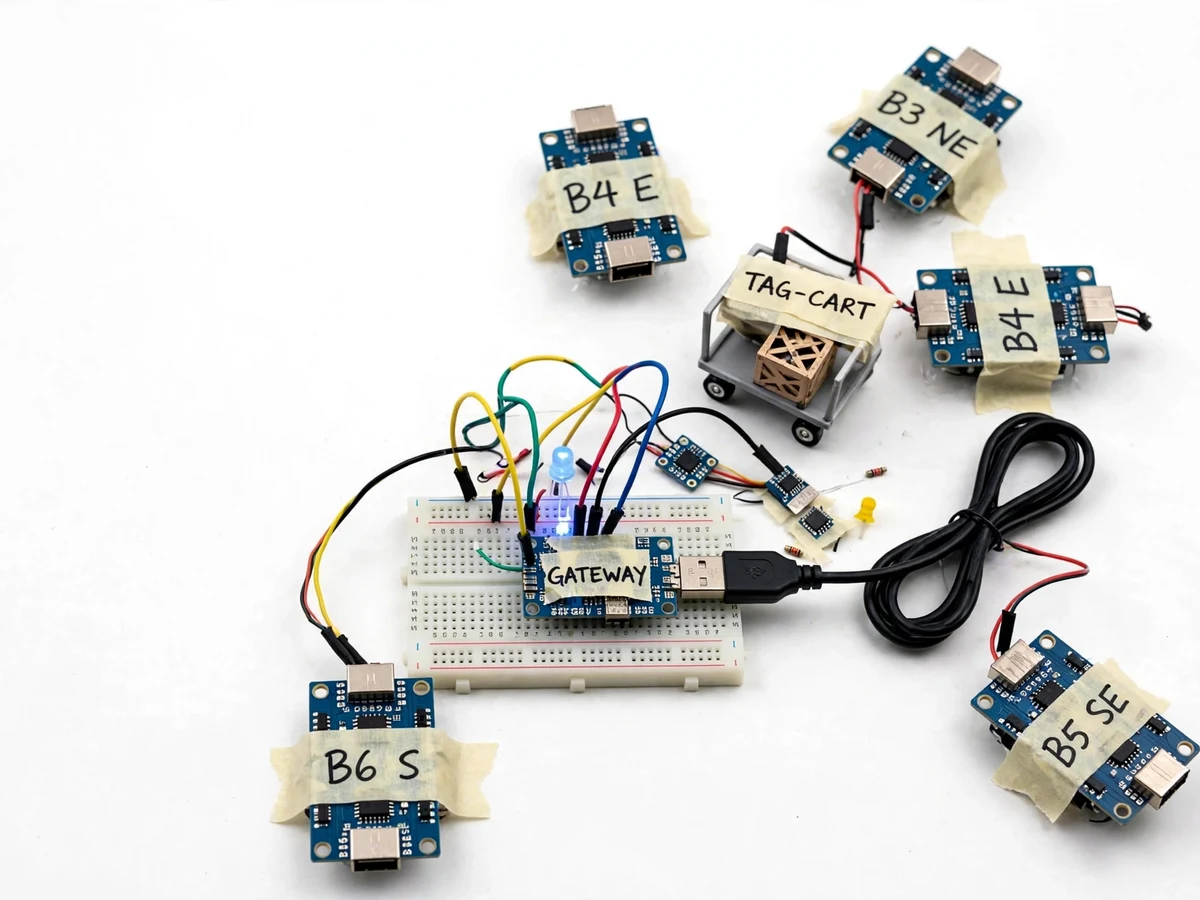
GPS stops at the front door: inside workshops, hospitals and warehouses, equipment goes missing because nobody knows which room it is in. This project brings positioning indoors with Bluetooth Low Energy: ESP32 beacons are fixed at known points on a scaled floor model, BLE tags ride on the assets, and a gateway ESP32 scans advertisements, converts RSSI to distance estimates, and trilaterates each tag's position. A web dashboard renders the floor map with live asset dots, zone assignments, and alerts when an asset leaves its assigned zone or a tag battery runs low. The project is rigorous about RSSI reality: signal strength is noisy and multipath-prone, so the report documents the filtering (moving averages, outlier rejection), states the achieved zone-level accuracy honestly, and explains why this is asset-zone tracking, not centimetre surveying.
How it works
- Eight ESP32 beacons are fixed at surveyed positions on the floor model and broadcast BLE advertisements with their IDs.
- BLE tags on the assets advertise at fixed intervals; the gateway ESP32 scans continuously and records RSSI per tag per beacon.
- Firmware applies a moving-average filter with outlier rejection to the RSSI stream and converts it to distance via the log-distance path-loss model.
- Trilateration from three or more beacons yields each tag's estimated position, published over Wi-Fi via MQTT.
- The dashboard plots live asset dots on the floor map, checks zone assignments, and logs zone-change events.
- When a tag leaves its assigned zone or its battery drops below threshold, an alert is raised with the asset ID.
- The buyer runs the beacon survey and path-loss calibration procedure documented in the manual.
Tech stack:
- ESP32 beacons x8 (fixed)
- BLE asset tags (coin-cell)
- ESP32 gateway (scanner)
- MQTT broker + web dashboard
- Arduino IDE (C/C++ firmware)
- Scaled floor model with zones
- Path-loss calibration utility
- Tag battery replacement kit
| Parameter | Value |
|---|---|
| Beacons | 8x ESP32 at surveyed positions |
| Tags | BLE asset tags, coin-cell, battery reporting |
| Positioning | RSSI trilateration with moving-average + outlier filter |
| Accuracy | Zone-level (approximately 2-3 m on the model scale, expected); not centimetre-grade |
| Update rate | Position refresh design target 5 s; events immediate |
| Dashboard | Live floor map, zone assignments, out-of-zone alerts, movement analytics |
| Zones | 4 configurable zones with per-asset assignment |
| Power | Beacons USB-powered; tags coin-cell (months, expected) |
Project features
- [BLE beacon network] Eight ESP32 beacons at fixed, known positions broadcast iBeacon-style advertisements across the floor model.
- [Asset tags] BLE tags on the model's assets advertise at intervals; coin-cell powered with battery-level reporting.
- [RSSI trilateration] The gateway converts filtered RSSI to distance estimates and trilaterates tag positions — real indoor-positioning math.
- [Live floor-map dashboard] Assets render as live dots on the floor schematic with zone labels, beacon positions and movement trails.
- [Zone enforcement] Each asset has an assigned zone; leaving it raises an out-of-zone alert with the asset ID and timestamp.
- [Tag battery watch] Tags report battery level; the dashboard flags tags needing replacement before they go dark.
- [Movement analytics] Zone-change events build the per-hour movement chart and the daily zone report used in the project report.
What is included
- Working floor model with 8 beacons, asset tags, gateway ESP32
- Complete firmware source (beacon FW, tag FW, gateway trilateration, MQTT)
- Live web dashboard (floor map, zones, alerts) demonstrated with the model
- Circuit and wiring documentation
- Beacon survey + path-loss calibration procedure
- Component list with ratings
- Project report PDF (indoor positioning background, BLE, RSSI physics, trilateration, methodology)
- PPT presentation for final review
- Viva Q&A preparation document (BLE, RSSI, trilateration, filtering, MQTT)
- Setup and demonstration guide
Limitations & prerequisites
- RSSI positioning is inherently noisy — accuracy is zone-level (approximately 2-3 m expected), not centimetre-grade; the report states this plainly with the filtering discussion.
- Demonstrated on a scaled floor model; real buildings add multipath, human-body shadowing and Wi-Fi interference that the manual discusses.
- Tags need periodic battery replacement; the dashboard warns but cannot prevent a dead tag.
- Trilateration needs three or more beacons in range — coverage gaps degrade to proximity-level fixes.
- Calibration (path-loss exponent, beacon survey) is per-installation; moving beacons invalidates the map until re-surveyed.
Frequently Asked Questions
How does it locate assets indoors?
BLE tags advertise; fixed ESP32 beacons' signals are scanned by the gateway, which converts filtered RSSI to distance estimates using the log-distance path-loss model and trilaterates each tag's position from three or more beacons — the standard approach for indoor positioning.
How accurate is it?
Zone-level: approximately 2-3 m on the demonstration scale (expected). RSSI is noisy and multipath-prone, so the system uses moving-average filtering and outlier rejection, and the report is honest that this is asset-zone tracking, not surveying.
What does the dashboard show?
A live floor map with asset dots, beacon positions, zone labels, per-asset zone assignments, out-of-zone alerts, tag battery status and the movement analytics chart.
What happens when an asset leaves its zone?
The dashboard raises an out-of-zone alert with the asset ID, the zones involved and the timestamp, and logs it to the event history.
How long do tag batteries last?
Coin-cell tags advertising at the configured interval last months (expected); tags report their battery level and the dashboard flags replacements before they go dark.
Is this project suitable for a final-year project?
Yes — for Electronics and Telecommunication programs. It covers BLE, RSSI physics, trilateration math, filtering and MQTT telemetry with an honest accuracy discussion, all strong viva material. Suitable for B.E./B.Tech final-year projects in Electronics and Telecommunication.
Components & software requirements
- ESP32 beacons x8 (fixed)
- BLE asset tags (coin-cell)
- ESP32 gateway (scanner)
- MQTT broker + web dashboard
- Arduino IDE (C/C++ firmware)
- Scaled floor model with zones
- Path-loss calibration utility
- Tag battery replacement kit
Delivery information
Built-to-order project. Delivery timeline is shared after order confirmation based on current queue.
Support terms
Complete documentation, setup guide, and viva preparation included. Support for setup and explanation provided.